Belonging Isn't a Server Name: Notes From the Away End
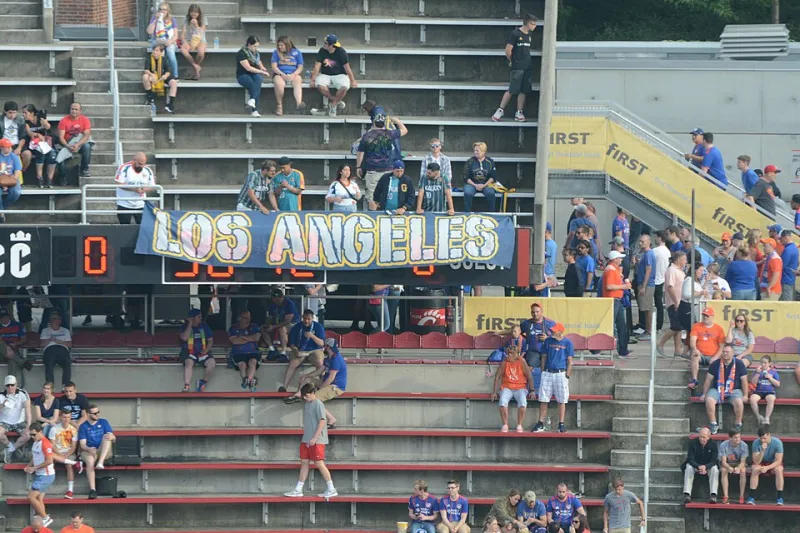
Photo: Hayden Schiff from Cincinnati, USA, CC BY 2.0, via Wikimedia Commons
There's a thing that happens on a Tuesday night in League One that no amount of Discord admin can fake. A few hundred people finish work, get a coach at half four, stand in a concrete corner in the rain for two hours, sing the same dozen songs they've been singing since they were teenagers, watch their team lose 2-0, and get home at one in the morning. Then they do it again a fortnight later.
Nobody's paying them. There's no prize pool. The only return is the feeling of having been there, together, with people who'd have noticed if they hadn't turned up.
Clan leads spend a lot of time trying to engineer that feeling with a rebrand and a new server icon. The away end does it with a flag, a drum and roughly forty years of accumulated habit. There's something worth nicking in that.
Ritual beats branding every time
Ask a supporter what their club means to them and you won't get a colour palette. You'll get a specific memory — the away trip nobody organised properly, the pub that had run out of everything by half two, the goal in the 94th minute. Belonging gets built out of things that happened, repeated on purpose.
Clans have this too; they just don't always notice it. The warm-up map you always run first. The daft name somebody gave the left-hand site on a particular map three years ago. The fact that Tuesday is clan night and has been since before half the roster joined. None of that shows up in a recruitment post, and all of it is the reason people log back in.
Practical takeaway: write down three rituals your clan already has, then protect them. Not in a rules document — in how you behave. The terrace equivalent is the song that gets sung at kick-off and again at full time. Nobody voted on it. It survives because people keep doing it.
The songbook is your onboarding doc
New supporters learn the songs by standing next to people who already know them. Nobody hands out a lyric sheet, and nobody gets quizzed on verse three before being allowed through the turnstile.
Clan onboarding tends to go the other way: a wall of text, a dozen channels, a rank ladder, a scrim schedule. All useful, none of it belonging. What actually makes a new member feel like they're in the right place is watching two veterans take the mickey out of each other in a way that is obviously affectionate, and then being invited to join in.
So make room for it. Spend the first couple of sessions with a new player doing the daft stuff in front of them, not explaining the daft stuff to them. Let them hear how your group talks before you ask them to talk like it.
Rivalry with edges, not mines
Football gets this right more often than the internet gives it credit for. You can spend ninety minutes loudly describing the opposition's left-back as a donkey and then have a perfectly civil chat with their lot on the train home. The rivalry is real, it's loud, and it's bounded — it ends with the whistle and it's about the shirt, not the person inside it.
Clans tend to get one half of that and miss the other. Either everyone's too polite to have a proper rivalry and the whole thing feels like a corporate away day, or the needle creeps from 'your mid player's aim is tragic' into something about a person's family, accent or where they're from. The first is boring. The second is a recruitment problem waiting to happen.
The bounded version looks like this: you have opponents you genuinely want to beat, you talk about them constantly, and there are three or four subjects that are simply out of bounds no matter how heated it gets. No exceptions, no 'he started it', no 'it's banter if everyone's laughing'. Because everyone isn't.
Look after the away fans
The best thing about terrace culture isn't the singing. It's that the home end knows the away support has travelled four hours and will still point them towards the station afterwards. There's an etiquette: they get their own corner, their own pub, and they get left alone in the car park.
Translated into clan terms: the new clan, the smaller clan, the team you just battered 13-2 in a scrim — they all deserve a bit of the same. Message the other captain afterwards. Don't clip the moment someone's mouse died mid-round. Don't post the scoreline with a snide caption. It costs nothing, and it means everybody keeps showing up, which is the entire point of a grassroots scene.
Internally, the same courtesy applies to the person having a bad night. Nobody's asking you to pretend a 4-13 loss was fine. Just don't be the reason someone quietly decides not to bother next week.
Where the line actually sits
Here's the blunt version. Banter punches up, at shared situations, at the game, at yourself. It doesn't punch down at who someone is. Your clan's line should be written down once, agreed by whoever's been around longest, and then actually enforced by the people with the loudest voices — not just by whoever happens to hold the moderator role.
Terraces have had decades to work this out and still get it wrong. You've got a Discord and a spreadsheet. Be quicker than they were.
The point of all of it
You can't manufacture an away end. What you can do is stop sanding off the bits that make one: the daft rituals you keep repeating, the humour that has an edge but knows where the fence is, and the small decency of looking after the people who turned up.
Do that for a year and somebody will write your clan's version of the 94th-minute goal into general chat. That's the thing you can't put in a recruitment post, and it's the only reason anyone's still here in 2026.